Course page
CS 486/686
Uninformed Search

Lecture 2

RN 3.1–3.4

Search Uncertainty Decisions Learning

Learning goals

  • Formulate problems as search
  • Trace DFS, BFS, IDS
  • Analyze: space, time, completeness, optimality
  • Pick the right algorithm

Heads-up: Chat 1 is live

Sign up: andromeda-208.cs.uwaterloo.ca

  • Use your WatIAM @uwaterloo.ca email (not your friendly one)
  • Verify the email Chrysalis sends; you'll be auto-added to CS 486/686
  • Chat 1 covers L1 + L2 — due Tue May 26, 11:59 PM (one-time extension for late enrollees)
  • Issues? Private Piazza post to Prashanth Arun & Robert Cai (Chrysalis designers)

Full instructions: course page → Chat Assignments with Chrysalis.

Where does search show up?
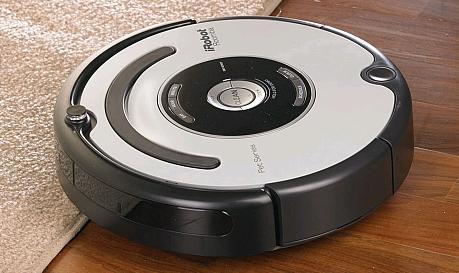
Roomba
Robotics
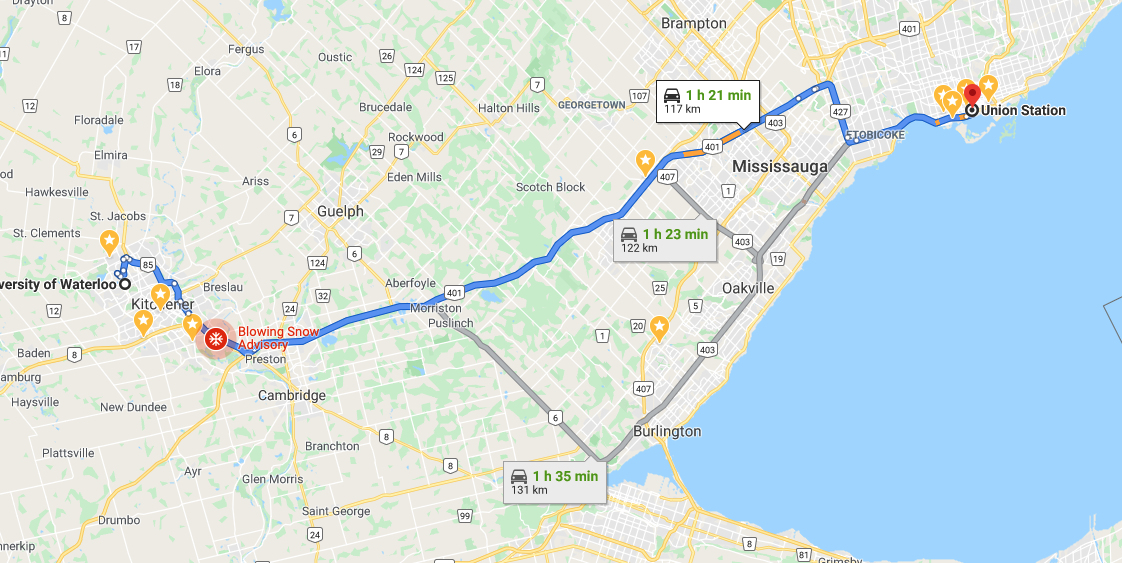
Route planning
Route planning
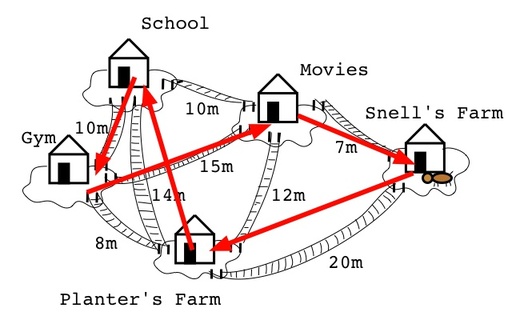
Travelling Salesperson
TSP
\( ((a \land b) \lor c) \land d \)
\( \lor (\neg e) \)
SAT
5
3
8
7
6
2
4
1
8-puzzle

River crossing puzzle
River crossing
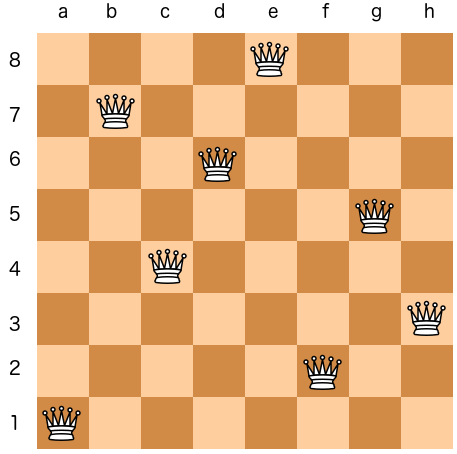
N-queens
N-queens
And many more

TSP: Quanta. SAT / FCC auction: UBC news.

Why search?

  • Sequential decisions
  • No closed-form algorithm
  • Easy to verify, hard to find
  • Systematic, not guesswork

What is a search problem?

Five components:

  • States
  • Initial state
  • Goal test
  • Successor function
  • Cost (optional)

Solution = path from start to goal.

State spaces are huge

1.8 × 10⁵
8-puzzle
3×3 sliding tile
1013
15-puzzle
4×4 sliding tile
4.3 × 10¹⁹
Rubik's cube
3×3×3

Too many states to enumerate. We need clever search.

Search graph

S D E P H R Q F C G
  • States → nodes
  • Actions → edges
  • Goal: find a path S → G

Search tree & frontier

frontier S D E P B C Q
  • Don't enumerate the graph
  • Grow a tree from S, one path at a time
  • Frontier = paths to expand next

Example: 8-puzzle

Initial
5
3
8
7
6
2
4
1
Goal
1
2
3
4
5
6
7
8
  • State: 9 positions, 0 = empty
  • Initial: 530,876,241
  • Goal: 123,456,780
  • Successor: slide adjacent tile into empty
  • Cost: 1 per move

181,440 reachable states — too many to enumerate.

Quick check: successors

Q. Which is a successor of 530,876,241?

  1. 350,876,241
  2. 536,870,241
  3. 537,806,241
  4. 538,076,241
Initial
5
3
8
7
6
2
4
1
B. Slide the 6 up.

Multiple formulations possible

  • State def → nodes
  • Successor → edges
  • Minimize both

Same 8-puzzle, different state

By grid
5
3
8
7
6
2
4
1

9 cells, 0–8

vs
By coordinates
\((x_0, y_0), (x_1, y_1),\)
\((x_2, y_2), \ldots, (x_8, y_8)\)

9 (x,y) pairs — ~2× the space

Successor swaps empty tile's coords with a neighbour's.

Generic search algorithm

// Inputs: graph, start node s, goal test goal(n)
function Search(graph, s, goal):
    frontier ← { <s> }
    while frontier is not empty:
        select and remove a path <n0, …, nk> from frontier
        if goal(nk):
            return <n0, …, nk>
        for each neighbour n of nk:
            add <n0, …, nk, n> to frontier
    return “no solution”
expand: pop path get neighbours push extended paths

One template, three algorithms

DFS, BFS, IDS all use this skeleton.

They differ only in which path they pull from the frontier.

Depth-first search (DFS)

  • Frontier = stack (LIFO)
  • Pop newest
  • Dive deep, then backtrack

Trace: DFS

Push children alphabetically. Step numbers = order of expansion.

Frontier: (S) (D, E, P) (D, E, Q) (D, E) (D, H, R) (D, H, F) (D, H, C, G) goal G reached!
S 1 D E P 2 Q 3 4 H R 5 F 6 C G 7 G

Evaluating search algorithms

Four questions we'll ask about every algorithm:

  • Space — how much memory? (worst-case frontier size)
  • Time — how many nodes does it visit? (worst case)
  • Complete? — is it guaranteed to find a goal if one exists?
  • Optimal? — does it return the cheapest (or shallowest) goal?

Tree parameters: \(b\), \(m\), \(d\)

S G b = 3 d = 1 m = 4

\(b\) — branching factor

\(d\) — depth of shallowest goal

\(m\) — max depth of tree

DFS — properties

Space\(O(bm)\) linear
Time\(O(b^m)\) exponential
Complete?No
Optimal?No

DFS fails on cycles

S H I J G

\(H \to I \to J \to H\) traps DFS forever.

Fix: cycle pruning

Keep a visited set. Skip states we've already expanded.

S H I J G

Order: S → H → I → J → back to H? skip! → G.

DFS takes the first goal, not the best

S D E P J F G

Returns the long path; ignores the shorter \(S \to D \dashrightarrow G\).

When to use DFS

Good fit

  • Memory limited
  • Many goals exist
  • Deep solutions

Bad fit

  • Cycles
  • Shallow solutions
  • Need optimality

Breadth-first search (BFS)

  • Frontier = queue (FIFO)
  • Pop oldest
  • Level by level

Trace: BFS

Pop the oldest path. Step number = order of expansion. Multiple paths to P and B.

Frontier: (S) pop S → push D, E, P  →  (D, E, P) pop D → push B, C  →  (E, P, B, C) pop E → push H, J  →  (P, B, C, H, J) pop P → push Q  →  (B, C, H, J, Q) pop B → push P  →  (C, H, J, Q, P) pop C, H, J  (leaves)  →  (Q, P) pop Q → push B, G  →  (P, B, G) pop P, B → push Q, P  →  (G, Q, P) pop G — goal!
S 1 D E P 2 B C 3 H J 4 Q 5 P 6 7 8 9 B G 10 11 Q P 12 G

BFS — properties

Space\(O(b^d)\) exponential
Time\(O(b^d)\) exponential
Complete?Yes
Optimal?Shallowest goal (optimal at equal cost)

When to use BFS

Good fit

  • Memory plentiful
  • Want fewest arcs
  • Cycles possible

Bad fit

  • Deep solutions
  • Large branching
  • Graph generated on the fly

What if edges have different costs?

1 5 10 1 S A B G

S→A→G: cost 11. S→B→G: cost 6.
BFS picks the wrong one (it's fewer hops, but pricier).

Uniform-cost search (UCS)

  • Frontier = priority queue
  • Key = path cost so far
  • Pop the cheapest path first

Complete + optimal when all costs are positive.

When every edge has cost 1, UCS = BFS. (We'll use BFS in this lecture for that reason.)

BFS vs DFS — Q1

Q. Memory is very limited.

  1. BFS
  2. DFS
  3. Both are fine
  4. Neither
B — DFS. DFS: \(O(bm)\) vs BFS: \(O(b^d)\).

BFS vs DFS — Q2

Q. All solutions are deep in the search tree.

  1. BFS
  2. DFS
  3. Both are fine
  4. Neither
B — DFS. Dives down long paths instead of enumerating every shallower level.

BFS vs DFS — Q3

Q. The graph contains cycles.

  1. BFS
  2. DFS
  3. Both are fine
  4. Neither
A — BFS. DFS can fail to find the goal (gets stuck going deeper into the cycle); BFS still finds any goal at finite depth. (BFS does waste work without cycle pruning — but it's complete.)

BFS vs DFS — Q4

Q. The branching factor is huge or infinite.

  1. BFS
  2. DFS
  3. Both are fine
  4. Neither
B — DFS. BFS's frontier blows up with \(b\); DFS stays linear.

BFS vs DFS — Q5

Q. You must find the shallowest goal.

  1. BFS
  2. DFS
  3. Both are fine
  4. Neither
A — BFS. BFS guarantees the shallowest goal.

BFS vs DFS — Q6

Q. All solutions are very shallow.

  1. BFS
  2. DFS
  3. Both are fine
  4. Neither
A — BFS. Checks shallow neighbours before diving deep.

BFS vs DFS tradeoff

BFS DFS
Space\(O(b^d)\)\(O(bm)\)
Complete?YesNo

Can we have both?

Why \(O(b^d)\) matters

Branching factor \(b = 10\), 1 state = 8 bytes, computer doing 109 states/sec.

Depth \(d\) States \(b^d\) BFS memory Wall-clock time
4 104 80 KB 10 µs
8 108 800 MB 0.1 s
12 1012 8 TB ~17 min
16 1016 80 PB ~4 months
20 1020 800 EB ~3000 years

Doubling \(d\) doesn't make the problem twice as hard. It makes it 10,000× harder.

Iterative-Deepening Search (IDS)

For \(\ell = 1, 2, 3, \ldots\), run DFS up to depth \(\ell\).

Stop when a goal is found.

Each iteration is depth-limited search (DLS).

Trace: IDS

Same graph as BFS. Each iteration is depth-limited DFS.

Depth limit: 1 — visit S only. 2 — visit S, P, E, D (DFS, alphabetical push order). 3 — explore level 3, no goal yet. 4 — S → P → Q → G. Goal found!
S 1
S 1 D 4 E 3 P 2
S 1 D 7 E 4 P 2 B 9 C 8 H 6 J 5 Q 3
S 1 P 2 Q 3 G 4

IDS — properties

Space\(O(bd)\) linear
Time\(O(b^d)\) exponential
Complete?Yes
Optimal?Shallowest goal

Summary: DFS vs BFS vs IDS

DFS BFS IDS
Frontier Stack (LIFO) Queue (FIFO) Stack, repeated at deeper limits
Space \(O(bm)\) \(O(b^d)\) \(O(bd)\)
Time \(O(b^m)\) \(O(b^d)\) \(O(b^d)\)
Complete? No Yes Yes
Optimal? No Shallowest goal Shallowest goal

\(b\) = branching factor; \(m\) = max depth of the search tree; \(d\) = depth of the shallowest goal.

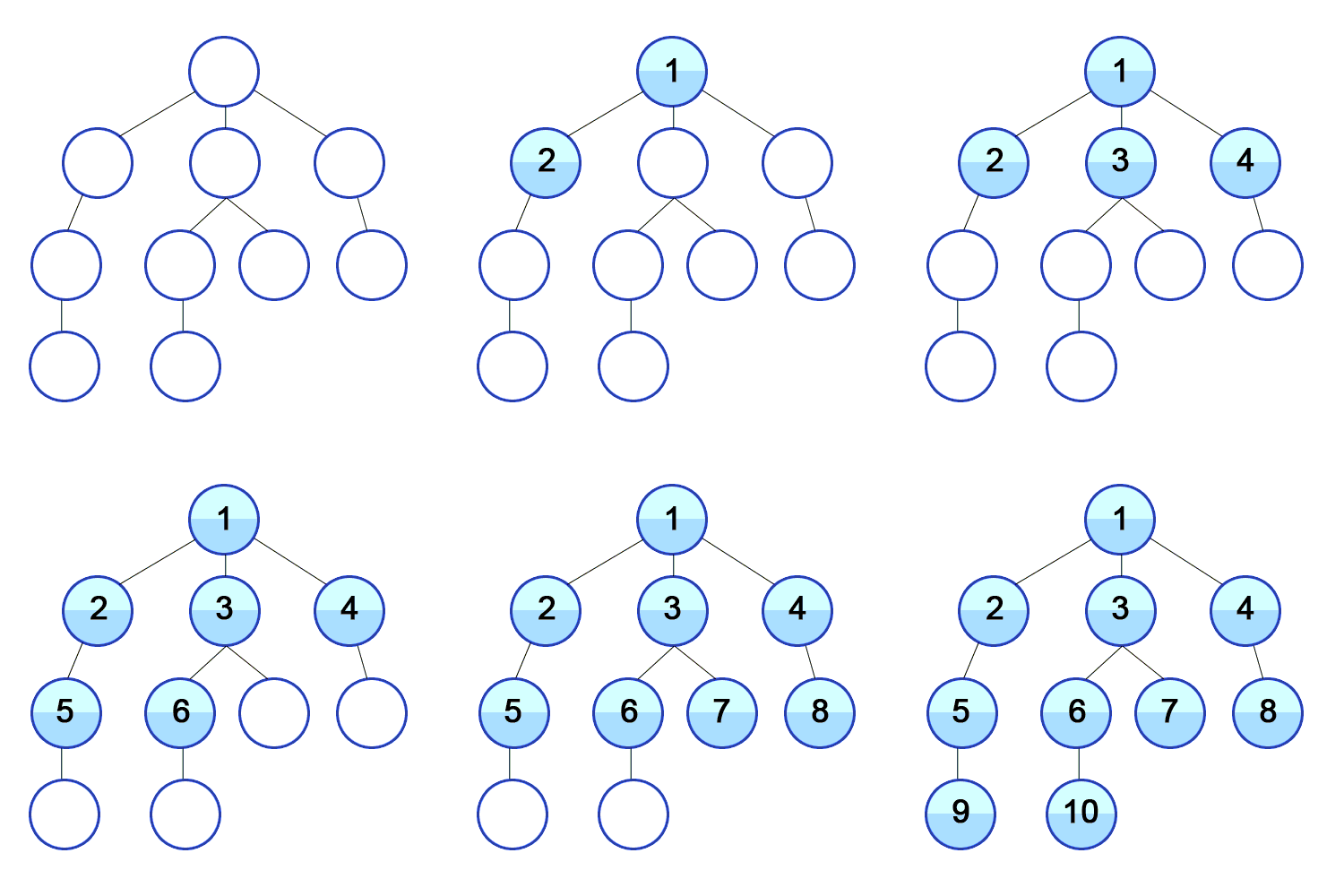
DFS vs BFS: exploration order
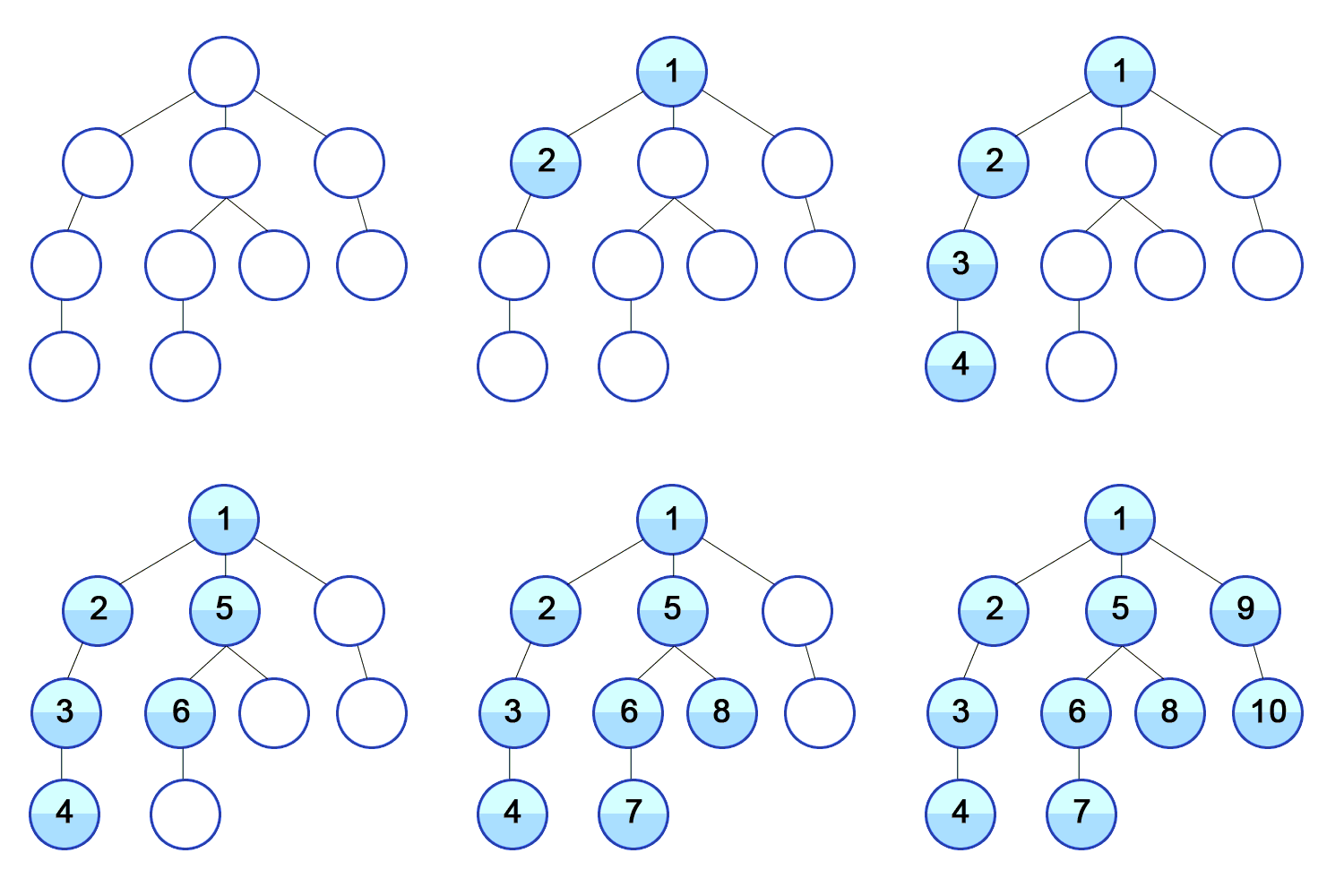
DFS exploring a graph
DFS — dives deep first
BFS exploring a graph
BFS — expands by level

Animations by Mre, Wikimedia Commons (CC BY-SA 3.0).

Learning goals (recap)

  • ✓ Formulate problems as search
  • ✓ Trace DFS, BFS, IDS
  • ✓ Analyze: space, time, completeness, optimality
  • ✓ Pick the right algorithm

Next lecture: informed search (heuristics, A*).

Next: informed search

Use a heuristic \(h(n)\) — an estimate of distance to the goal — to bias the search.

S G low \(h\) = closer to goal far close

A* combines path cost so far (\(g(n)\)) with heuristic (\(h(n)\)) — provably optimal under mild conditions.